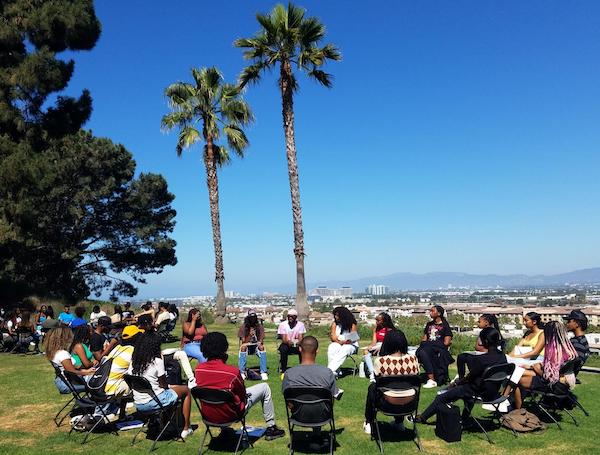
The LMU TCHT Alliance provides a hub for campus and community partners to transform the culture and climate of institutions by catalyzing equitable, reciprocal, and authentic relationships through Ignatian reflection, intergroup dialogue, and Story Circles.
Vision
Inspired by our university mission, the Truth, Community Healing, and Transformation (TCHT) Alliance at Loyola Marymount University will transform our campus culture through humanization, dialogue, and belongingness.
Goals
- Serve as a Hub for Healing, Restorative Practice, and Generative Conflict: Coordinate cross-campus and community efforts to address harm, strengthen relationships, and cultivate a culture of accountability and belonging through restorative and healing-centered frameworks.
-
- Continue to develop a collective understanding among students, staff, faculty, and community partners of the need to intentionally prioritize proactive relationship-building as a foundation for making generative conflict possible.
-
- Leverage partnerships among TCHT, the Office of Cultural Connection & Belonging, the Ombuds Office, affinity groups, and community-based organizations to expand restorative justice practices.
-
- Continue to build capacity among faculty, staff, students, and community members through training in restorative practices, dialogue facilitation, conflict transformation, trauma-informed engagement, and healing-centered approaches.
- Advance Narrative Change and Mission Integration: More transparently articulate the connections between the TCHT framework, LMU's Catholic, Jesuit, and Marymount mission, and the pursuit of equity and justice.
-
- Express the relationship between truth-telling, cura personalis, Ignatian Pedagogy, Catholic Social Teaching, and community healing.
-
- Foster interfaith engagement that strengthens belonging and deepens understanding across differences.
-
- Advocate for and centralize reconciliation efforts related to colonialism, enslavement, settler colonialism, and other harmful practices initiated by institutions, including the Catholic Church.
- Promote Structural Equity and Collective Transformation: Identify and address institutional and societal systems that perpetuate inequities while advancing policies and practices that support thriving communities.
-
- Through partnership with the Inclusive History and Images Project (IHIP), promote a more complete understanding of LMU’s histories related to race, colonization, enslavement, migration, and systemic inequities through educational programming, storytelling, and public scholarship.
-
- Collaborate with Loyola Marymount University’s Department of Health and Human Sciences, Human Resources Wellbeing, and community organizations to promote culturally responsive and community-centered approaches to wellness, healing, and prevention.
The TCHT Alliance offers facilitated circles and other workshops by request for departments, units, and other groups at LMU. We also provide capacity-building opportunities for faculty, staff, and students interested in building their capacity to engage in dialogue across differences to facilitate spaces that catalyze growth, change, and a sense of belonging among all community members.
Facilitation Offerings
Promoting a Sense of Belonging
Community Building and Problem-Solving Circle: This process invites participants to join a group conversation. A trained, multipartial LMU facilitator invites the group to determine the topic(s) ahead of time. Embodying a meaningful way to enhance and strengthen the campus community, these conversations break down barriers and in the case of problem-solving circles, offer a process for decision-making. The aim is to help build a positive campus climate where everyone can potentially feel heard and valued.
Story Circle: The signature practice of the TRHT national network are Rx Racial Healing Circles, which we call story circles at LMU. Story circles provide opportunities for participants to self-reflect on the experiences that have shaped them and to be witnessed in sharing their experiences with others through a process where they are supported in engaging authentically.
Intergroup Dialogue: Receive a workshop facilitated through a justice-focused lens that centers topics like collaboration, the characteristics of identity, red-lining, and more.
Restorative Conferences: The Restorative Conference is a safe, structured way to invite people in conflict, along with their supporters, to address harm. Neither a counseling nor a mediation process, conferencing is a participant-sensitive, straightforward method requiring a trained and multipartial facilitator to help guide a conversation about the incident and how it affects everyone. The facilitator ensures everyone gets a chance to speak, however, the facilitator is not an active participant. The outcomes are approved by all of the participants and when an agreement is reached, a document is written and signed to provide a roadmap for future interactions. The Restorative Conferencing facilitator asks the group three key questions:
Restorative Practices Individual Consultation: An informal meeting with a trained facilitator to talk about a conflict, explore how you're feeling, what your goals are, and brainstorm an action plan for next steps. Through assessment-driven coaching, you will gain some tools for having difficult conversations and identify ways to follow up on what you're currently experiencing.
Restorative Practices Facilitation: An informal process that assists groups in respectful dialogue, collaborative decision-making, establishing, or resetting group norms and expectations. A multipartial staff member guides the facilitation to help two or more people achieve mutual understanding or reach a decision. The goal of facilitation is to help individuals and groups efficiently and collaboratively work together toward their larger common goals and interests.
Skill Building
Building a Culture of Encounter: This interactive workshop equips participants with practical tools to build deeper understanding, strengthen relationships, and navigate difficult conversations with greater confidence and compassion. Through the lens of active listening and nonviolent communication, participants will explore universal human needs and feelings while examining how implicit bias, trauma, and power dynamics shape the way we communicate and connect. Participants will also learn the principles of multipartiality as a framework for fostering trust and ensuring every voice is heard, while exploring a variety of dialogue modalities that create spaces for authentic storytelling, meaningful reflection, and collaborative learning. Whether in workplaces, classrooms, or community settings, this workshop provides practical, equity-centered approaches for cultivating empathy, bridging differences, and building more inclusive and resilient relationships.
Conflict Intelligence: Conflict is unavoidable—but how we respond to it makes all the difference. This workshop introduces Conflict Intelligence (CIQ), the capacity to do the right thing at the right time in response to different types of conflict. CIQ equips participants with the insight, tools, and confidence to navigate challenging moments with clarity, empathy, and purpose. Through interactive activities, reflection, and real-world scenarios, participants will explore the five core competencies of CIQ: self, social, situational, structural, and systemic conflict skills. Whether you're a leader, teammate, educator, or community member, this workshop will deepen your awareness and expand your toolkit for responding to conflict constructively. You’ll leave better prepared to transform difficult interactions into opportunities for connection, learning, and growth.
Generative Conflict: Five-Part Listening: This interactive workshop is designed to support you in preparing to engage conflict skillfully and in ways that can strengthen relationships and build community in generative ways. Participants will engage with foundational tools drawn from the traditions of restorative justice practices (RJ/RP) and nonviolent communication (NVC).
Generative Conflict: Difficult Conversations: This interactive session will invite participants to deepen their practice of addressing conflict skillfully through an exploration of conflict avoidance, cultivating our capacity for discernment related how to approach conflict skillfully, and by practicing how to implement distinct strategies for engaging in difficult conversations in productive ways.
Generative Conflict: I-Messages: Participants will practice on an essential strategy for deepening self-awareness through a needs-based framework that can help to de-escalate conflict and invite others into a collaborative mode of relating about an issue or conflict that needs to be addressed. By developing, practicing, and reflecting on I-messages, new insights will be revealed about the root causes of conflict within interpersonal relationships that can lead to creative and collaborative problem-solving.
Generative Conflict: Nervous System Fluency & Assertive Communication Participants will engage in strategies to increase nervous system fluency, which serves as a foundation for self-awareness in how to address conflict skillfully. Opportunities will be provided for further reflection on positionality related to a range of identities and will be supported in interrogating how our perspectives on and experiences with power dynamics influence our ability to communicate assertively.
Generative Conflict: Presupposition and Multipartiality: This dynamic workshop invites participants to explore presupposition through powerful psychological concepts like implicit bias, cognitive distortions, neutrality, and multipartiality in a hands-on, interactive way. Through engaging activities, we will uncover ideas that twist our perception of reality and explore how they shape our interactions. With practical tools and thought-provoking discussions, you’ll leave empowered to challenge your own thinking, become a more empathetic communicator, and create more inclusive spaces wherever you go.
Assessment Driven Coaching
Prices cover the license for the assessment and require a 1:1 meeting with a trained facilitator.
The CDP-I report contains graphs measuring constructive behaviors, destructive behaviors, and hot buttons. It is accompanied by a 40-page Development Guide which gives suggestions for improving behaviors and cooling hot buttons.
The CDP-360 report is much more comprehensive. In addition to containing graphs measuring constructive behaviors, destructive behaviors, and hot buttons, it also has narrative comments from other raters, measures of the organizational importance of various conflict behaviors, and indications of how the individual is viewed during different stages of conflict. Accompanying the CDP-360 report is a 115-page Development Guide with suggestions for development, recommended resources, and guidelines for successful action planning.
Intercultural Development Inventory®: The IDI measures individuals’ and groups’ placement along the Intercultural Development Continuum (IDC). The IDC describes orientations toward cultural differences ranging from the more monocultural mindsets of Denial and Polarization through the transitional orientation of Minimization to the intercultural mindsets of Acceptance and Adaptation.
Intercultural Conflict Style Inventory®: The Intercultural Conflict Style Inventory is an 18-item questionnaire that is available online (in multiple languages) and in print (English language) versions. The ICS Inventory is an easy to use, cross-culturally validated assessment of an individual’s approach to communicating, resolving conflicts and solving problems. The ICS Inventory takes 15 minutes to complete. The online ICS Inventory has been professionally “back translated” into multiple languages using rigorous, scientific protocols to insure each of the items possess both linguistic and conceptual equivalency. This ensures that the various language versions of the online ICS Inventory have similar meaning across cultures. We recommend the ICS Inventory be used with individuals 15 years of age or higher.
Framework
The TCHT framework helps communities heal and produce actionable change. From the beginning, TCHT was designed by the community and through collaboration. Community-led collaboration – that is cross-racial, intergenerational, and cross-sector – remains the centerpiece of all TCHT efforts.
Foundational Areas
All TCHT communities address the following foundational areas:
Narrative Change
False narratives hamper our ability to understand our world and relationships as they are, leading us to create and reinforce untrue perceptions. A complete story needs to be presented in school curricula, news media, movies, television, radio, digital media, gaming platforms, cultural institutions, and in the personal histories told within families. This process influences our perspectives, perceptions, behaviors, and interactions with one another so that we can more effectively create change.
Community Healing and Relationship Building
We are focusing on ways for all of us to heal from the wounds of the past, to build mutually respectful relationships across racial and ethnic lines that honor and value each person’s humanity, and to build trusting intergenerational and diverse community relationships that better reflect our shared humanity.
Pillars
Communities also choose to pursue work around one or all of the following pillars:
Separation
We are examining and finding ways to address segregation, colonization, and concentrated poverty in neighborhoods to ensure equitable access to health, education, and jobs.
Law
Review discriminatory civil and criminal laws and the public policies that result from them and recommend solutions that will produce a just application of the law.
Economy
Studying structured inequality and barriers to economic opportunities and recommending approaches to create an equitable society.
Truth, Community Healing, and Transformation
- TCHT Philosophy & Framework
- We Hold These Truths: Dismantling Racial Hierarchies; Building Equitable Communities
- National Day of Racial Healing
Restorative Culture
- Southern CA Restorative Justice Consortium
- Gathering Power
- Conflict Transformation and Restorative Justice
- In It Together – A Framework for Conflict Transformation
- Body Centered Transformation
- Accountable Communities Consortium
- Creating a Restorative Campus
- Developing a More Restorative Pedagogy
Antiracism
- LMU’s Antiracism Project
- Mission & Ministry’s Compiled Resources
- Characteristics of White Supremacy Culture
- AWARE-LA
- "The Benefits of Collective Action" by Heather McGhee